
By Will Barber Taylor
In her final days, author Edith Nesbit recounts the chilling tale of newlywed Victorians Jack and Laura.
The couple are settling into a small cottage in a quiet village when their idyll is overshadowed by the superstitious warnings of their housekeeper, Mrs Dorman, and the legend of the village church’s tomb effigies-a pair of marble knights who are said to rise from their slabs on Christmas Eve…
The tradition of telling ghost stories around a fire at yuletide is one that has often said to have its roots in the Victorian era. It of course has its origins in much older traditions – as Mamillius remarks in The Winter’s Tale “A sad tale’s best for winter: I have one/ Of sprites and goblins.” Yet the Victorians were the pioneers of creating such Christmas treats; from Charles Dickens in A Christmas Carol to M.R. James who would delight his undergraduates with reading them classic ghost stories, they were instrumental in connecting the festive season with the telling of tall and horrifying tales.
This tradition, taking specific inspiration from James, was later brought to television in the early 1970s with the A Ghost Story for Christmas strand overseen by director Laurence Gordon Clark. Since 2013 Mark Gatiss has contributed to the tradition by writing and directing a new series of adaptations of classic ghost stories from the pen of M R James and last year, Arthur Conan Doyle. Like Gordon Clark’s earlier series, Gatiss has made gathering round the television on Christmas Eve to witness a new adaptation of a classic ghost story unfolding an unmissable event. The latest story continues the diversion from adapting just the work of James and instead adapts Man Size in Marble by Edith Nesbit.
James’ reputation as the master of the horrific is well earned but he was far from the only late 19th century and early twentieth century author to contribute to the genre. Alongside Conan Doyle, the likes of Nesbit, E F Benson (today best known for his Mapp and Lucia novels) and many more besides made the ghost story as chilling and captivating on the page as its television versions have become on the small screen.
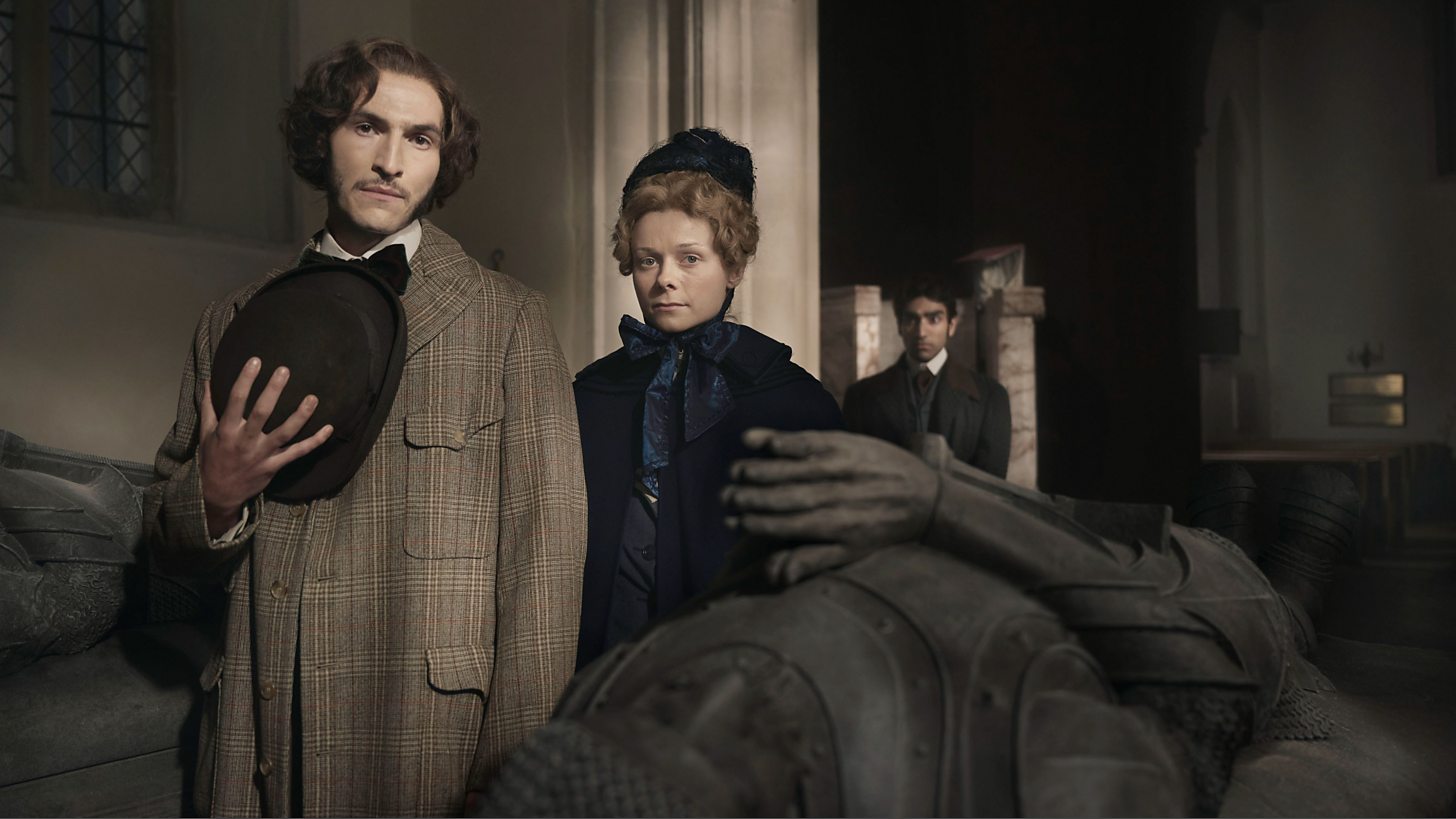
In this latest adaptation, Gatiss creates a framing story linking the dying Edith Nesbit in the 1920s to a variation of one of her stories that she tells the young doctor attending her, inserting the doctor into the story itself. Gattis’ adaptation makes clear the implicit link between the characters in her story – the newlyweds Jack (Eanna Hardwicke) and Laura (Phoebe Horn)- and Nesbit and her own husband, the adulterous Hubert Bland a well-known philander and political journalist who like Jack likes to act like a bohemian whilst also displaying many of the attributes of a chauvinistic man of the period. The altered ending to the story, in which Jack’s disbelief in the supernatural causes him to face the untimely consequences of his scepticism of the supernatural, is well in keeping with the overall theme both of the original text and of Gatiss’ well-timed adaptation – the belief that a man always knows best, that logic can in the face of the unknown must always triumph.
Gatiss’ decision to make the implicit nature of the story, the husband who is unwilling to listen to his wife or his housekeeper because he knows best and make it a commentary both on the role of women in the late Victorian era and of Nesbitt’s life is an excellent one. He provides extra depth both to Jack and Laura – Jack as the narrator is in fact unnamed in the original text – with Jack especially being better defined as a struggling artist who patronises his wife for her literary efforts and at times acts violently towards her. The bond between Doctor Zubin (Mawaan Rizwan) and Laura, both feeling outsiders to the seemingly idyllic countryside they find themselves in, further adds resonance to the drama’s underlying theme of sexual repression and the relationship between man and wife. The legend of the knights who will kill any unfaithful woman and Jack’s paranoia about Laura’s fidelity intertwine perfectly and suggest that not much had changed between the middle ages and the late Victorian era; for all of his apparent liberalism and bohemian attitude to life, Jack is as controlling and misogynistic in his own way as the knights frozen forever in the local church.
All of the performances are excellent. From Celia Imrie’s Edith Nesbit, resolute in the face of death but with a touch of melancholy to her to Enna Hardwicke’s Jack, filled with a sense of his own self-importance that is slowly peeled away as the story progresses, each actor brings something to their performance. Hardwicke’s overly jovial performance is particularly excellent serving as the linchpin of the story – a man who is unconcerned with delving deeper either into how his wife feels about their relationship, marriage or about the local legend that proves both of their undoing. Had his performance been played slightly differently the story would not have been as convincing – he perfectly hits the right balance between glibness and sincerity, to suggest there is both real horror at the death of his wife and that it is easy to understand why he would be immediately thought of as her killer.
Phoebe Horn’s portrayal of Laura as a conflicted woman who is trying to make her marriage work whilst also dealing with Jack’s continual disappointments and his changes in temper brings both realism and a sense of desperation to her performance. She is desperately trapped, attempting to salvage the situation that she finds herself in and is ultimately tragically made to pay the price for her marriage to an insensitive husband.
Visually, Gatiss perfectly captures the dark interior of the church and ensures that all the scenes set in it have a truly haunting quality to them. The cold, heartless nature of the effigies is reflected in the rest of the church and immediately gives the impression of an utterly emotionless, ruthless absence of love and affection, the kind of rage that drives many of the classic spectres from ghost stories. The contrast with the cozy cottage that Jack and Laura inhabit which is especially well rendered in the final sequences of the film, with the sudden violent cold stone creatures entering into the warmth of the cottage being an appropriately shocking disparity that Gatiss uses to his advantage.
Woman of Stone is both a timely adaptation an an enjoyable ghost story in its own right, mixing the original text with subtext and biographical details from Nesbit’s life to create a truly compelling tale of cruelty across the age, but also a prime example of the struggles women have often undergone throughout history. It can only be hoped that the tradition of Ghost Stories for Christmas can be continued in the future as they are welcome part of the BBC’s schedule allowing for often lesser-known literature to get its appropriate moment in the spotlight.
Woman of Stone can be watched on the BBC iPlayer here.
 The Consulting Detective
Enjoyed the review but sorry will have to disagree with you on this one, thought it lacked any real tension particularly given how creepy the original story is.
i don’t want to be a pendant too but the lack of care with the basics was irritating, set at Christmas and the trees in full leaf, a supposedly abandoned village church is a beautifully maintained estate church etc.
i am exceptionally grateful to Mark G for keeping the Ghost Stories for Christmas strand going but maybe time for him to stand back for a couple of years and let someone else have a go?
Enjoyed the review but sorry will have to disagree with you on this one, thought it lacked any real tension particularly given how creepy the original story is.
i don’t want to be a pendant too but the lack of care with the basics was irritating, set at Christmas and the trees in full leaf, a supposedly abandoned village church is a beautifully maintained estate church etc.
i am exceptionally grateful to Mark G for keeping the Ghost Stories for Christmas strand going but maybe time for him to stand back for a couple of years and let someone else have a go?