
By Will Barber Taylor
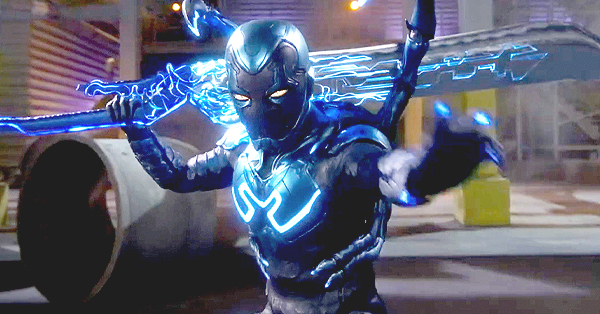
Recent college grad Jaime Reyes returns home full of aspirations for his future, only to find that home is not quite as he left it. As he searches to find his purpose in the world, fate intervenes when Jaime unexpectedly finds himself in possession of an ancient relic of alien biotechnology: the Scarab. When the Scarab suddenly chooses Jaime to be its symbiotic host, he is bestowed with an incredible suit of armour capable of extraordinary and unpredictable powers, forever changing his destiny as he becomes the Blue Beetle.
Jaime Reyes is an iconic character. The third Blue Beetle, he is perhaps the most successful of the legacy characters that DC has created and shown that the mantle of a superhero can be successfully passed from one iconic incumbent, in this case Ted Kord, to a worthy successor. It is unfortunate therefore that his first cinematic outing is so utterly fine. This shouldn’t be such a searing indictment of the film; there isn’t anything wrong with a film simply being “fine.” But with a character as interesting as Jaime, unique in the super hero world not simply for his heritage but how integral his family is to his story – one of the few families that know their relative is a superhero from the very beginning, or at least it was Jaime first debuted in 2006 – it’s a shame that the end result of an adaptation of his story and character should end up being so paint by numbers.
Everything connects from one point to the another and the film isn’t dull enough to switch off or as off puttingly bad as other recent DC efforts like The Flash, but it simply lacks the zest that you should expect from the Blue Beetle. For example, the removal of Jaime’s best friends Paco and Brenda from the film feels like an attempt to focus simply on Jaime’s family and place the focus on that family unit; this is ultimately not as interesting as if Paco and Brenda had been involved in the film simply because the dynamic between the three of them is one of the most humanising and endearing parts of the original Reyes run of comics. Similarly, the death of Jaime’s father – something not present in the comics – feels like a dull inclusion, expected almost to give the hero a dark and gritty backstory and to provide drama but not of any great substance. It’s very easy to introduce a character related to the central protagonist and then to kill them off to make the audience feel endearment and sadness towards the hero, making us want to root for them. The problem is that ultimately you don’t feel that because how often this trope has been repeated in superhero media; Jaime is different because he doesn’t have that happen to his family. The joy of Jaime’s character and his relationship with his family and friends is what made him so readable in the first place and to not have that same joy and creativity properly translated to the big screen is ultimately disappointing.
Visually, part of the issues with the film lies in that it could easily be mistaken for an Iron Man film. The fights between Jaime and Lieutenant Carapax, whether at the start of the film when Carapax’s armour looks more akin to something from a CW superhero show like The Flash than a multimillion dollar budgeted movie, or at the end when Carapax has been fully transformed into an OMAC, look like poor imitations of the fights between Stark and his various adversaries in the first Iron Man film. The interaction feels far from distinct despite the Blue Beetle being a starkly different character to Iron Man something which is ably demonstrated in the comic books that the film is based on, but which is not successfully translated to the big screen.
The concept of the OMACs is equally underdeveloped and implications of creating an army of cyborg like humans is far from fully explored. In contrast to X Men 97, which when taking a similar concept of the humanised Sentinels fleshed out the implications it could have for the individuals who submitted to the programme and their own motivation for why they would do that, the OMACs are glossed over as an interesting idea to simply be rendered as the means to and end. It’s a bad thing that the bad guys want so we have to stop it, is how the film essentially presents the idea with no more depth than that. In the brief flashback to Carapax’s past, one which has apparently been wiped by Victoria Kord, we get nothing concrete into why he should wish to undergo the process of being turned into an OMAC other than the insinuation he has been brainwashed (how this is achieved is conveyed neither visually or verbally) and the suggestion that he had nothing let to live for. This feels, give he is one of the film’s main antagonists, albeit in a minor way compared to Victoria Kord, far from satisfying and underscores the central problem with the film that it’s attempting to ape pretty much every other superhero film in needing an adversary who is somewhat misunderstood or who isn’t really bad and redeems themselves in some way at the climax of the film. The failure to make Carapax or the OMAC programme, both of which are handled exceedingly well by writers in the original comics, interesting or unique ends up making Blue Beetle lack the distinctiveness that it needs to stand out in a heavily crowded market of competing superhero projects and franchises.
Ultimately the greatest flaw in the Blue Beetle film is that it takes a source material that is far richer and intricate than many other superheroes concept and makes it far plainer. The acting is all fine; Xolo Maridueña gives a very charming, believable performance as Jaime and Susan Sarandon gives a wonderfully full-blooded villainous turn as Victoria Kord. But there is so much more than could have been done with this film and it’s a shame that the potential that it had just feels ultimately wasted. This may change with any future sequel but for the moment Jaime Reyes has been sadly let down by DC.
 The Consulting Detective