
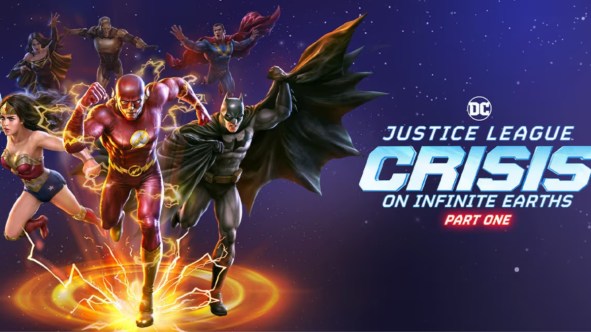
By Will Barber Taylor
Death is coming. Worse than death: oblivion. Not just for our Earth, but for everyone, everywhere, in every universe! Against this ultimate destruction, the mysterious Monitor has gathered the greatest team of Superheroes ever assembled. But what can the combined might of Superman, Wonder Woman, Batman, The Flash, Green Lantern and hundreds of Superheroes from multiple Earths even do to save all of reality from an unstoppable antimatter Armageddon?!
Crisis on Infinite Earths is a story that stands apart from so many others in the history of comic books. Its scale was, for the 1980s, unprecedented. Its purpose was clear – to reboot the entirety of DC’s then near 50 year canon. As time went on, the publishers realized that it was impossible for readers to not be confused by the years of continuity that had naturally built up as characters grew. The solution was clear – they needed to wipe the slate clean. The entire universe would be rebooted after a cosmic battle of epic proportions between the forces of good and the forces of evil, represented by the apocalyptic Anti Monitor who wished his own anti matter universe would consume our world.
Crisis on Infinite Earths would set the standard for how company wide crossover events would be done in the future, setting a patten replicated both by its publishers DC and their main rival Marvel as well. Yet the potency of the original story, despite the many sequels, allusions and copy cats it has generated over the year, has never gone away. That’s why it’s not only been adapted for television to provide the plot for the last major multishow crossover of the Arrowverse, but also for the DC Universe Animated Original Movie range. Spread across three parts, this is perhaps DC animation’s most ambitious project yet. The films are attempting to tell the original story and also tie into both the Tomorrowverse and the DC Animated Movie Universe films that preceded it. It’s no mean task and the first part does somewhat suffer from having to deal with so many juggling balls.
In part the issue lies in the fact that the Tomorrowverse has been somewhat sporadic in its linearity and as such, despite having already seen the Justice League of this universe active and dealing with a variety of different threats, this film is partly an origin story for the team. It makes sense, given that The Flash is effectively the main character of this film, to show various different points in his life from gaining his power and first meeting Iris to forming the Justice League and visiting Earth 3 to the current events of the Crisis. This version of Barry Allen feels almost like a DC version of time traveller Henry DeTamble from The Time Traveler’s Wife, unable to keep control of his life and flitting between his past, present and future. Barry’s desire for some sense of stability is answered towards the end of the film when he and Iris sacrifice years of their life in order to help stop the Anti Matter wave that otherwise seems ready to wipe out the entire multiverse.
Whilst it is understandable that the producers, given The Flash’s importance to the Crisis on Infinite Earth’s saga, chose to focus on him and the story possibilities of his ability to journey throughout time, the film suffers as a result of this. It feels more like a character portrait of Barry Allen with a story involving the JLA’s origin that feels like padding rather than a justifiable addition to the plot of the original Crisis. This isn’t to say that the film doesn’t have enjoyable moments – the focus on The Flash allows us to feel like he is a fully fleshed out character. Barry Allen in the film is torn between wanting to be a hero and to have something of a normal life with his wife; a wish he partly achieves at the end of the film. Yet it also feels like the hour and a half running time is somewhat inflated and had DC wanted to make the story into a trilogy of films, this first part should have been an hour at most.
The first part of Justice League: Crisis on Infinite Earth is therefore a decent enough film but one that clearly suffers from that inevitable fate of so many works that are lengthened in order to sell the story in more parts (The Hobbit, Harry Potter and The Hunger Games all similarly suffered from this) – it becomes a bit of a drag and doesn’t keep the audience’s interest. Hopefully when Part Two is released, it will stick to the original text a bit more closely and not feel like it suffers from padding.
 The Consulting Detective