
By Will Barber Taylor
Doctor Who turns sixty this year, a massive feat for a television programme that has faced cancellation more than once. The show was, and is, one of those strange and quixotic creations that exists both as an individual franchise and yet as a frame of reference – most people in the UK know what a Dalek is and have heard of the TARDIS despite a good chunk of the population having likely never seen an episode.
Such is the scope of the franchise that, of course, it has transitioned from its original medium of television into others. Perhaps most notably are the Big Finish Doctor Who audios that have an interlinked relationship with the TV series. A lot of what has subsequently become successful on the small screen started out as a Big Finish audio.
Yet Big Finish audios aren’t the only form of entertainment that Doctor Who has taken over. The show has, since a year after it first aired, also been responsible for a range of books as well. Originally starting out as novelisations of the TV show’s stories, by the time Doctor Who was first cancelled in 1989 the idea of creating original novels as supplicants for the TV series became an idea worth pursuing. Between 1991 and 2005 a series of original Doctor Who novels were published, initially by Virgin Media and subsequently by BBC Books, firstly featuring the Seventh Doctor and eventually encompassing all of the first 8 incarnations of the mysterious time traveller. When the series returned in 2005 the books continued to be published, this time featuring the current TV incarnation of The Doctor.
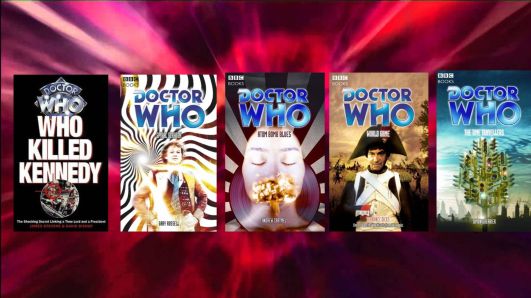
In that nearly ten years of output over 250 original novels were published. Today these books are still read and still enjoyed but perhaps not to the extent that they should be. So, here is my list of the five best Doctor Who novels from this era that you might not have read.
1: The Time Travellers by Simon Guerrier
It can be difficult to capture the original TARDIS team’s unique appeal; the sullen and at times rude 1st Doctor; the curious and naïve Susan; the two school teachers Ian and Barbara, both school teachers taken out of time and trying their best to cope of the strange world they have found themselves in.
In this novel, Simon Guerrier nails these characterizations perfectly whilst bringing to life a plot that feels like it could be from a modern blockbuster. Finally thinking they have arrived back home, albeit forty years in their future, Ian and Barbara soon discover that things really have changed on Earth.
Guerrier’s novel is a masterpiece into how to deal with one of the shows stickiest staples – the concept of time travel itself – and makes it as much a human tragedy as a core principle of the show. The grimness of the situation the Doctor and his friends find themselves in is as great as they will when Susan finally leaves the TARDIS crew in The Dalek Invasion of Earth.
Guerrier forces our main characters to face their own mortality and show that travelling through time and space isn’t often a picnic. It is a superb example of how what can often feel gimmicky, messing with time, can be dealt with in a way that is as tragic as any great Shakespearian epic.
2: World Game by Terrance Dicks
The Second Doctor’s attempts to undo the harm wrought by the War Lords cost him his freedom and forced him to regenerate. However, as Terrance Dicks explores in this story, the Time Lords had a few jobs for The Doctor to do before his exile to Earth; namely to tidy up the last of the War Lords untidy games and stop any further interreference in Earth’s history.
Set against the backdrop of the Napoleonic conflict with The Doctor and his unwilling companion, Time Lady and aspiring politician Lady Serena (a retroactive pro Romana), must stop the villainous attempts of the Countess to manipulate events to allow Napoleon to win the Napoleonic wars. The Countess is pitted against other intergalactic beings who decide to play god with human affairs in order to alleviate boredom.
What Dicks achieves in this novel is a masterstroke of writing elegance and plot juggling that never tires or bores the reader. His depiction of the Napoleonic period is brilliantly done with Napoleon, Wellington, Talleyrand and Nelson being brought to life with exceptional accuracy. Equally, Dicks’ depiction of Time Lord politics feels genuinely engaging. This is no mean feat in itself, as often the Time Lords are at their dullest when they involved in intergalactic power struggles.
Finally, Dicks wraps the novel together is an effective and genuinely delightful companion to The Doctor in the form of Lady Serena, a character who is fully The Doctor’s equal and whose shock at finding herself in the middle of one of The Doctor’s strange adventures and outside the far more serene and orderly world of the Time Lords is as endearing as it is amusing.
3: Who Killed Kennedy? by David Bishop
Journalism and Doctor Who always conjure up in the minds of Doctor Who fans Sarah Jane Smith, companion to the Third and Fourth Doctor. However, in David Bishop’s excellent novel, journalist James Stevens is at the centre of an attempt to uncover the startling web of conspiracies that seem to be covering up the adventures of the Third Doctor and his friends in 70s Britain.
This spin on the Doctor Who stories of the 70s allows for Bishop to not only show how someone viewing these events from the outside might reasonably interpret them, but also create a thrilling investigative novel that subverts the expectations of fans. It is perhaps the most unique Doctor Who novel, because in many ways it could easily not be a Doctor Who novel; Stevens is such a compelling character in his own right and the story such an interesting one that the novel would be as interesting if the Doctor Who elements were released. That Who Killed Kennedy? could stand on its own feet without being a Doctor Who novels and yet is so perfect as a Doctor Who novels goes to show the quality of Bishop’s writing and his skill at creating a book that connects so effortlessly with the rest of the Doctor Who universe and yet could easily be outside it.
4: Spiral Scratch by Gary Russell
The Sixth Doctor has, unfortunately, often been dealt the worst card when it comes TV appearances. Yet, in the expanded media world of Big Finish and the Doctor Who novels range he has been given some proper respect. In Spiral Scratch, Gary Russell presents a true multiverse saving final outing for the Sixth Doctor, seeing him having to not only save the universe and all of time and space but every universe that has ever existed.
The grand scale of the story does not stop Russell from writing some excellent character moments for the Sixth Doctor who finally gets the heroic end he deserved to receive in 1986. Spiral Scratch should be read not simply because it is a Doctor Who story on an astonishing scale but also because it allows for one of the Time Lord’s most maligned incarnations to have a real moment in the sun.
5: Atom Bomb Blues by Andrew Cartmel
With the current popularity of Christopher Nolan’s latest epic Oppenheimer, it would be remiss of me not to include the novel that first introduced me to the father of the Atom Bomb – Atom Bomb Blues. Set during the Manhattan Project’s final stages, it sees the Seventh Doctor and Ace facing an attempt to turn the nuclear nature of the project into one that wouldn’t just be used to end the Second World War but end humanity itself.
Cartmel of course was at the heart of the Seventh Doctor’s era, and he is at his best when he is able to fully explore both the Seventh Doctor’s manipulative side and write a story that is on a scale that could never have been achieved by a late 1980s BBC TV budget. Atom Bomb Blues explores both the complex morality surrounding the Manhattan Project and the meaning of interfering in history in a subtle and engaging way that feels not only like an exciting Doctor Who story but also an opportunity to examine the destructive nature of humanity.
All these novels are pretty hard to get hold of which is perhaps why you might not have read them. However, I would highly recommend checking them out because each of them offers a compelling, engaging and above all unique take on the traditional Doctor Who story.
 The Consulting Detective